

Bourbons in Frohsdorf
The story of the Duchess of Angoulême — daughter of Louis XVI and Marie Antoinette — and her exile at Frohsdorf Castle in Lower Austria.
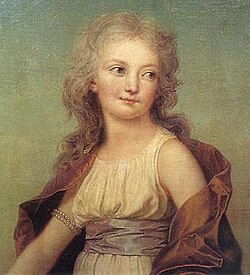
Marie Thérèse Charlotte de France — later the Duchess of Angoulême (born 1778) — was the daughter of the French royal couple Louis XVI and Marie Antoinette (daughter of Maria Theresa), who were executed in 1795 during the French Revolution. After the death of her parents, Marie Thérèse Charlotte de France remained imprisoned in France until the Austrian imperial family succeeded, through diplomatic channels — via an exchange with imprisoned Frenchmen — in bringing her to Vienna, where she then lived for a time at the court of Emperor Francis I.
Her brother, unofficially called Louis XVII , the rightful heir to the throne, was taken in by the prison guard Simon, who after years reported the heir’s death. However, this news of his death has remained highly mysterious to this day. In any case, Louis XVII remained missing. A man named Naundorff from Berlin later came forward and claimed to be the French heir to the throne. He followed his alleged sister, but never received an audience with her. On her deathbed, she is said to have told a General Laroche Jacquelin: “My brother did not die — that is the nightmare of my entire life.”
In Austria, Marie Thérèse Charlotte de France married her cousin Louis Antoine de Bourbon, Duke of Angoulême (son of her uncle Charles X) in 1799. After Napoleon’s fall, she returned to France with Louis XVIII (her father’s brother) and confronted Napoleon with courage and determination when he returned from Elba for 100 days.
“This duchess is the only man in the Bourbon family.”
— Napoleon Bonaparte
Marie Thérèse Charlotte de France
| Born | 1778 · Paris |
| Parents | Louis XVI × M. Antoinette |
| Marriage | 1799 Duke of Angoulême |
| Frohsdorf from | 1844 |
| Died | Oct. 19, 1851 · Frohsdorf |
| Heir | Count of Chambord |
Frohsdorf Castle from 1844
The ducal couple of Angoulême remained childless. However, they took in their nephew Henri, Duke of Bordeaux, Count of Chambord early on in order to raise him as the French heir to the throne. Henri was born in Paris on September 20, 1820, seven months after his father (the Duke of Berry, brother of the Duke of Angoulême) was murdered in front of the Paris Opera. His birth caused great joy in legitimist circles, as it secured the continuation of the House of Bourbon.
In 1830, his grandfather Charles X was forced to abdicate in favor of his grandson. On April 29, 1832, his mother, Marie Caroline, Countess of Berry, attempted to place the then twelve-year-old Henri on the throne — the attempt failed completely. The ducal couple of Angoulême and the Count of Chambord lived for some time in the Waldviertel (Kirchberg am Walde); for the winter they had a residence befitting their rank in Gorizia (Italy).
After the death of the Duke of Angoulême in 1844, the duchess purchased Frohsdorf Castle, which then became her summer residence. Loyal French royalists followed the Count of Chambord and offered their services — thus a true French colony arose in Frohsdorf, in a sense a government in exile. The Duchess of Angoulême was very close friends with Archduchess Sophie, who often came to Frohsdorf with her sons Franz Joseph (later emperor) and Maximilian.
In 1845, the duchess had the “New House” built for the servants (16 rooms). In 1848, she brought a hundred workers from Vienna to Frohsdorf, who built protective embankments on both sides of the Leitha between Lanzenkirchen and Frohsdorf.
Always dressed in black, the Duchess of Angoulême was a very serious, taciturn, hard woman, yet socially committed and deeply religious. She attended the early Mass every day at 5 o’clock. Nevertheless, she was not free of thoughts of revenge: in the castle chapel she kept a piece of the bloodstained shirt her father Louis XVI had worn at his execution. She always spent the anniversary of her parents’ execution alone before this relic. It is claimed that when praying the “Our Father” she omitted the words “as we forgive those who trespass against us.”
She died on October 19, 1851 in Frohsdorf, before completion of the convent with girls’ school she had planned. She was transported by rail in a funeral carriage to Gorizia and buried there in the Bourbon family crypt.
“History will scarcely be able to cite a second example of someone to whom the cup of suffering was offered with such bitterness as to this exalted king’s daughter.”
— Parish priest Ignaz Löffler, Lanzenkirchen · Obituary 1851
The heir of the Duchess of Angoulême was Henri, Duke of Bordeaux, Count of Chambord, the rightful French heir to the throne. On November 16, 1846, in Bruck an der Mur, he married Maria Theresia Beatrix, Archduchess of Austria-Este.
§ The missing will
Charlotte de France is said to have drawn up a will that may only be opened 100 years after her death — that is, in 1951.
It is suspected that in this will she recorded the truth about her brother. The will has disappeared in a strange manner. It was handed over to the bishop at the time — and it is therefore assumed that the will is in the Vatican. Publication could significantly influence the worldview and any potential rights to property.