

Press Articles on the Royal Connection
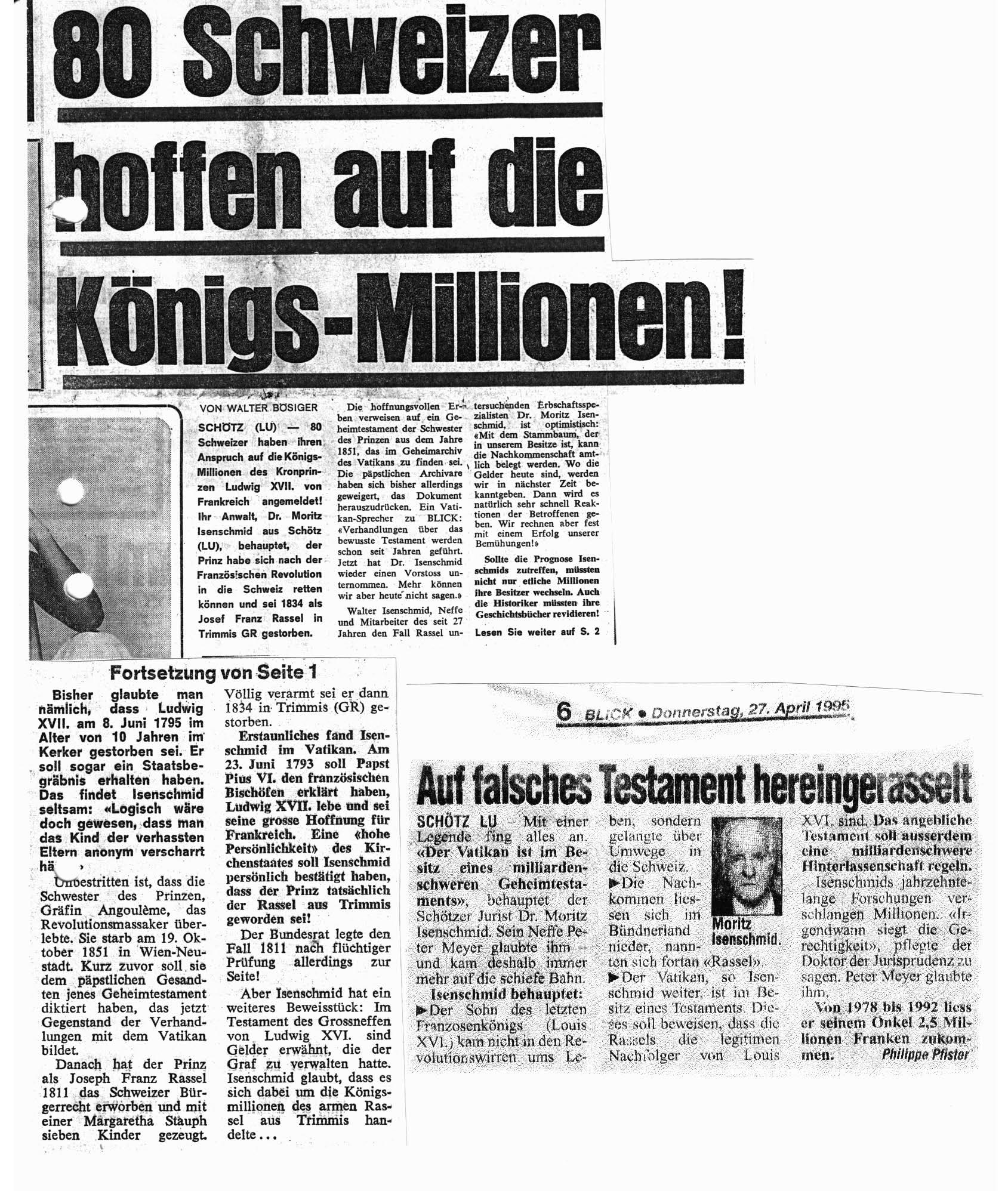
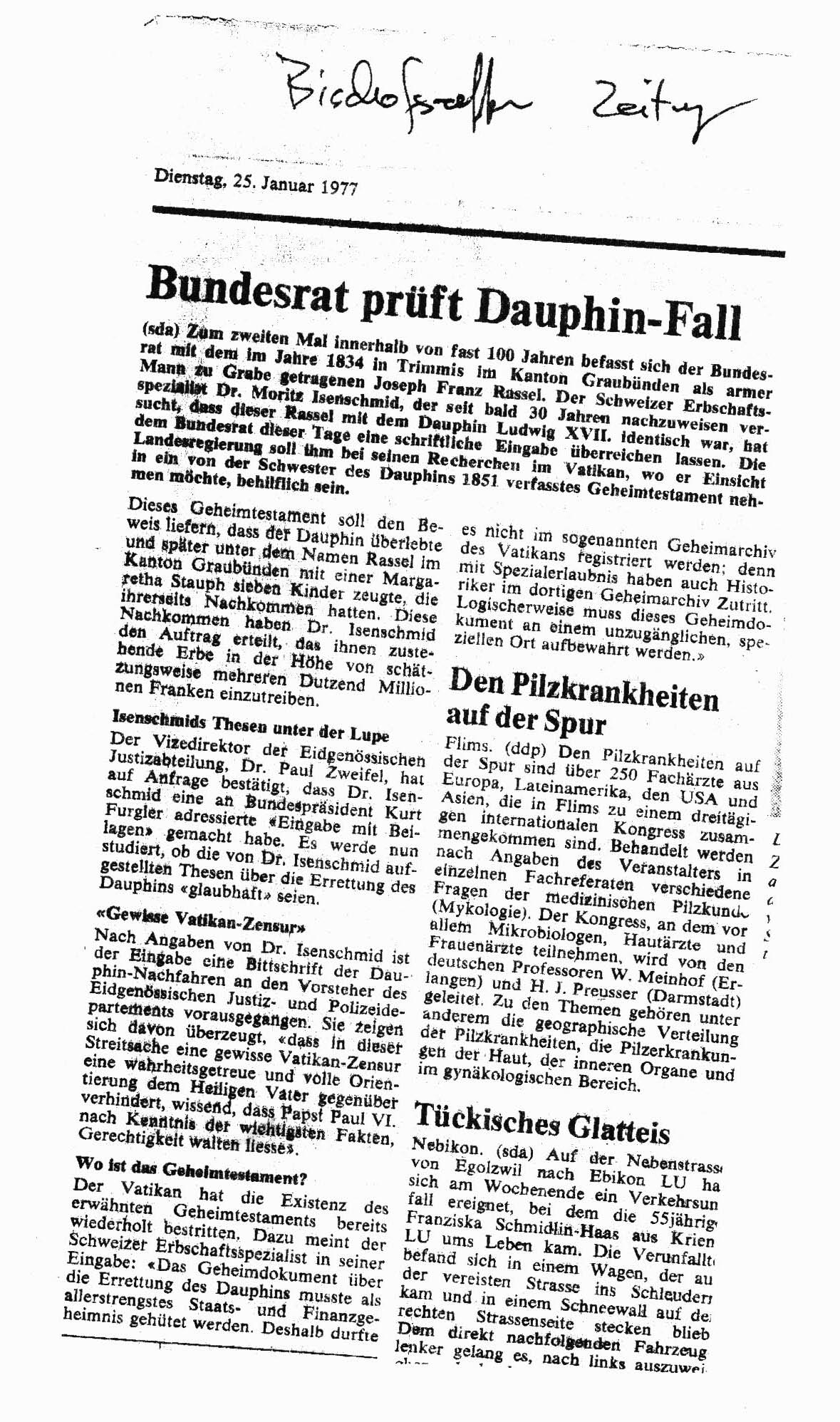
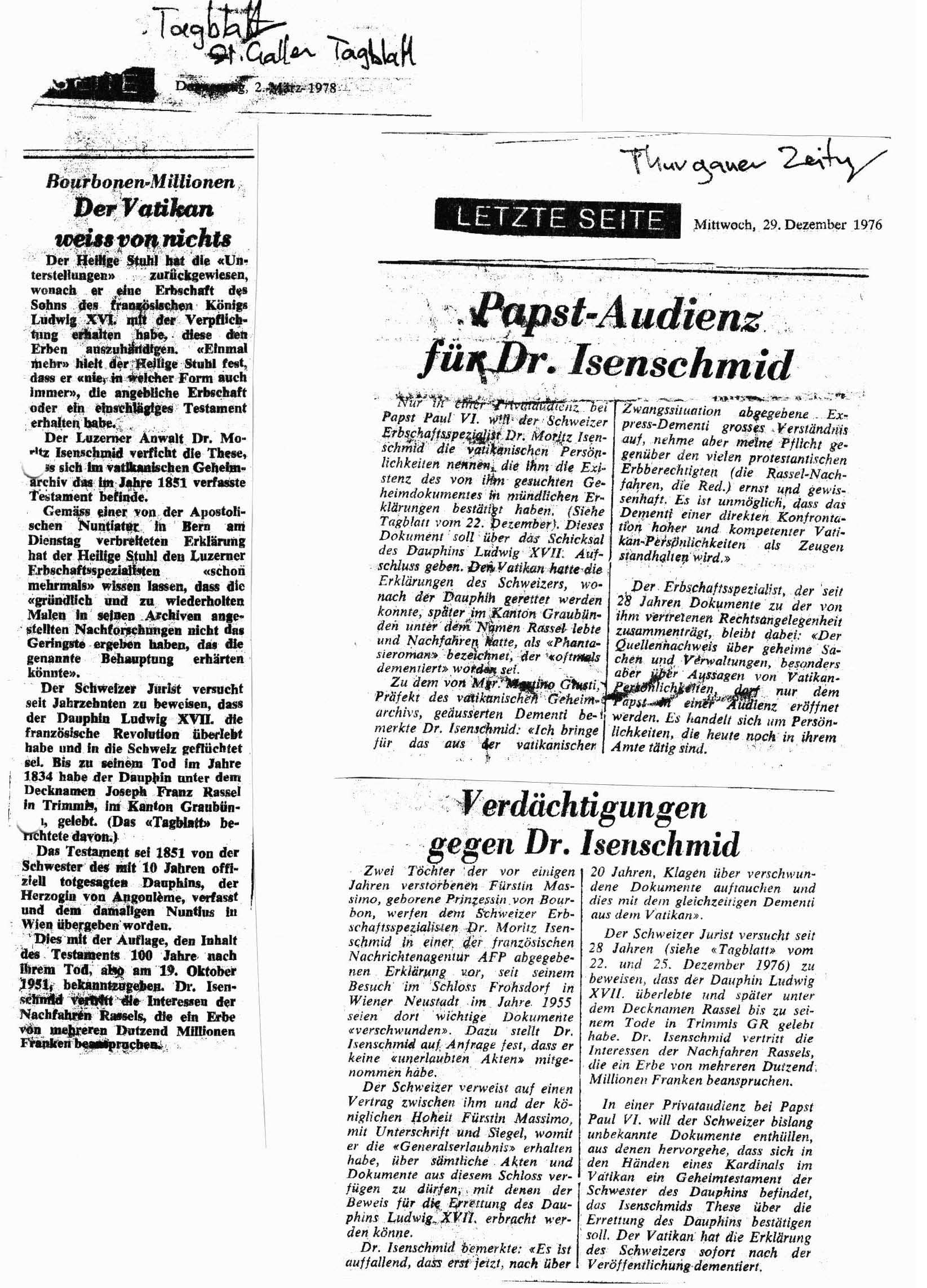
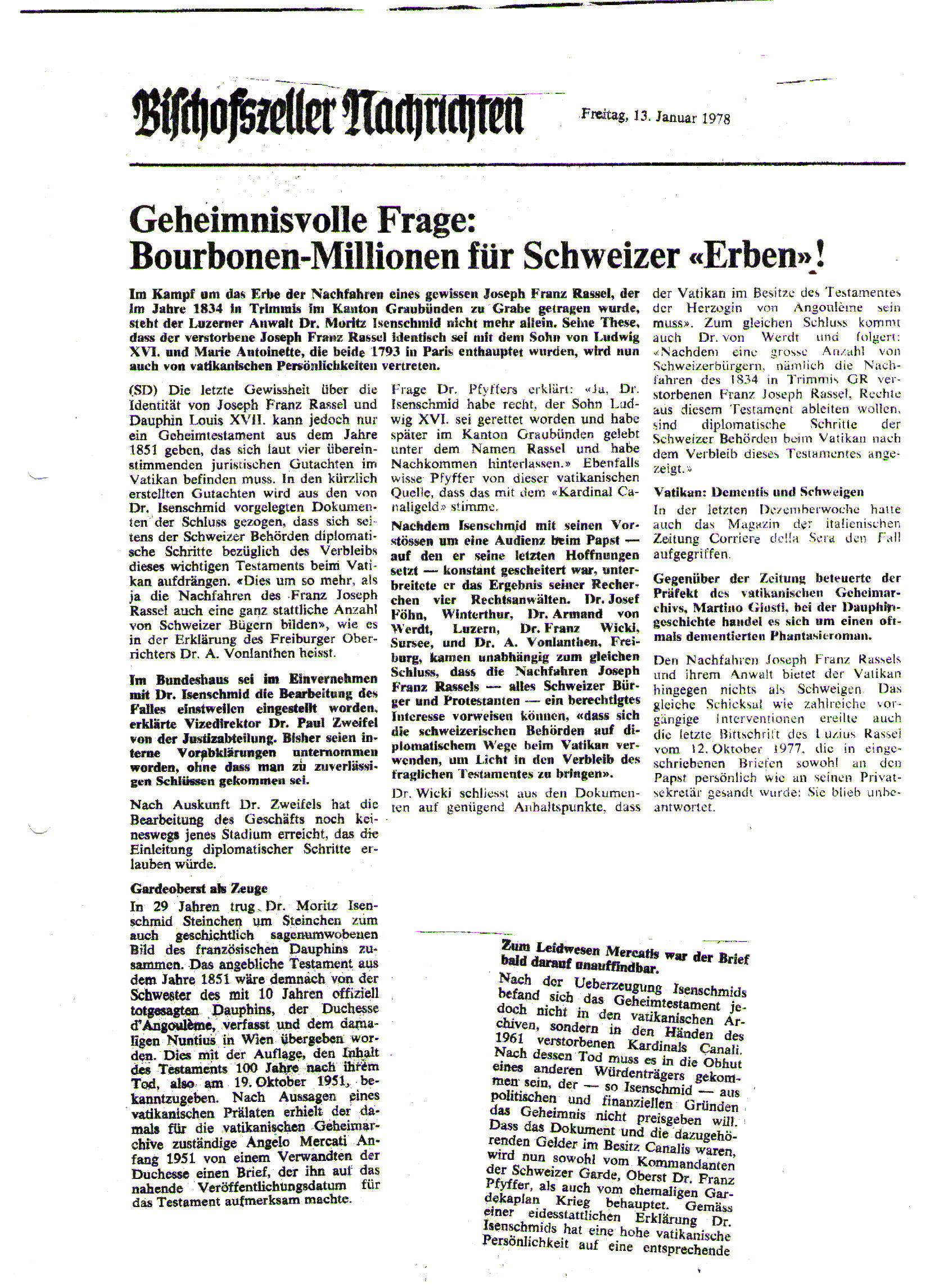
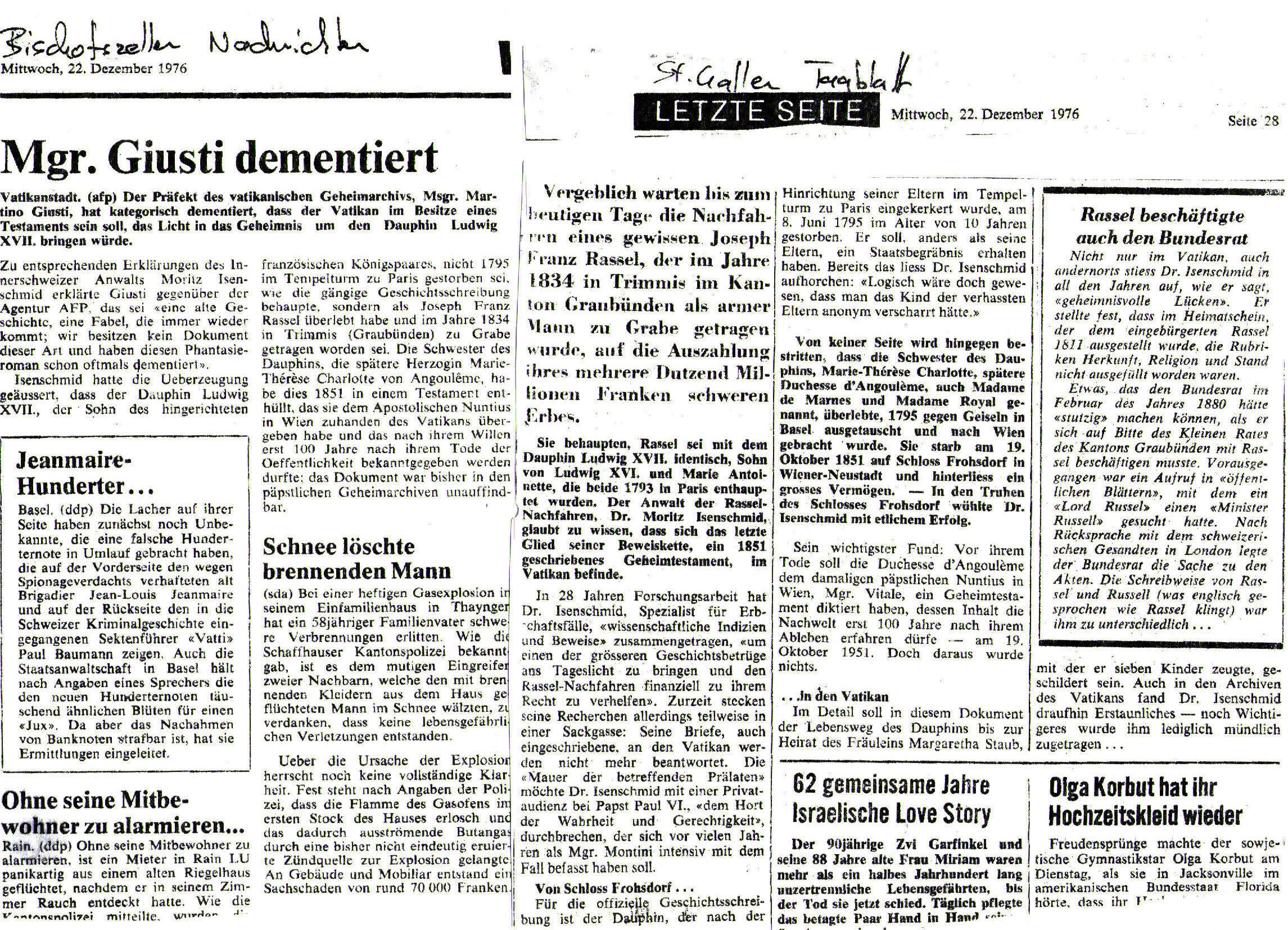
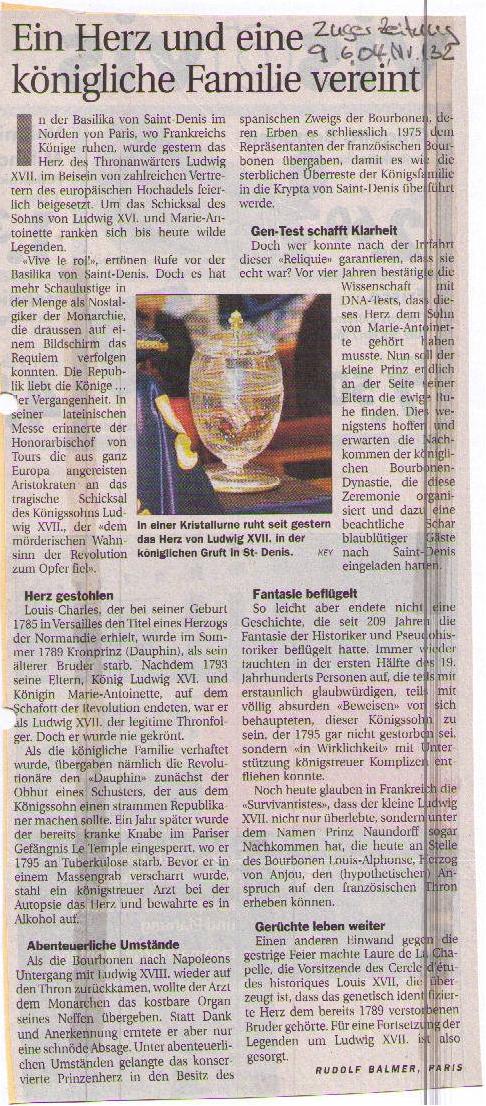
The “inheritance case” was not only written about—no, a great deal of work was also devoted to it. Among others, Dr. Moritz Isenschmid also dealt with the case. There was even a letter to the Federal Council and a visit to the Vatican in Rome. Excerpts from the press articles are listed below. In addition, there is an interesting book and a report about it.
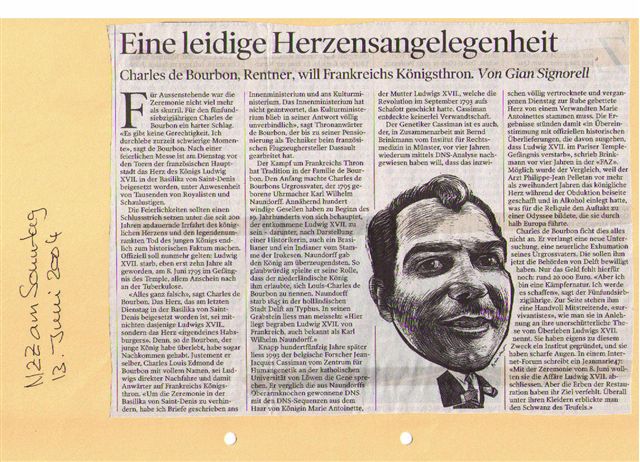
The following article appeared on June 13, 2004 in NZZ am Sonntag (No. 24, p. 21) under the title “A Troublesome Matter of the Heart,” written by Gian Signorell. It reports on Charles de Bourbon, retiree (75), great-great-grandson of Naundorff—and his claim to the French throne.
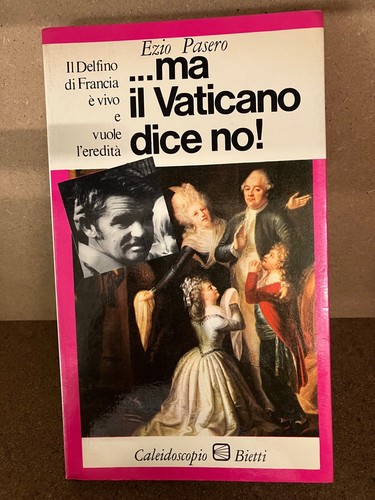
Book on the Subject
Ezio Pasero
Italian · 114 pages
Book available with Roland Bonadurer.
Ezio Pasero book on the subject
IIs a Swiss lumberjack, Luzius Rassel, the heir to the King of France? First-hand eyewitness accounts and documents that contradict the official history say: the Dauphin did not die as a child in the Temple prison during the French Revolution, but was rescued in a daring operation and taken to England. From there, a fascinating story unfolds, documented with evidence right up to the present day. An old lawyer in particular, Dr. Moritz Isenschmid, has taken care of collecting it. For thirty years he has tirelessly knocked on the Vatican’s doors. For it is precisely there that confirmation of the Rassels’ true identity is said to be found: the secret will of the Dauphin’s sister, Marie Thérèse Charlotte, which, by her order, should have been opened one hundred years after her death, i.e. in 1951. But the will was never opened; its very existence is even denied, and Isenschmid is refused the audience he seeks with the Pope to present the evidence he has gathered. None of it is true, they say in the Vatican. And yet there are so many claims to the contrary, coming from within the holy palaces…
Ezio Pasero, 34 years old, a journalist, covers many of the most important current events for Il Messaggero in Rome. During this time, he mainly has to deal with “traces” and terrorist conspiracies. Almost by chance, he came across a disinherited and boycotted king: a “trace” with so many intrigues and secrets, stretching across almost two centuries.
Ezio Pasero, 1979 — "...ma il Vaticano dice no!" · German Translation (PDF)+
Ezio Pasero · Original language: Italian · 6 parts · 1979
German translation for Roland Bonadurer, 2026
The journalist Ezio Pasero published a six-part article in an Italian newspaper in 1979 about the case of Luzius Russel from St. Antönien, Canton of Graubünden—a Swiss man who claimed to be the rightful heir to the French throne. His lawyer, Dr. Moritz Isenschmid, conducted decades of research and repeatedly encountered the same obstacle: the Vatican.
The Vatican is said to hold the secret testament of Madame Royale, Duchess of Angoulême—the sister of the allegedly surviving Dauphin Louis Charles. She stipulated that the document should only be opened one hundred years after her death. The deadline expired on October 19, 1951. The Vatican opened nothing. It did not respond. It did not deny.
Below is the complete German translation of the article in all 6 parts as a PDF.
Ezio Pasero · 1979 · Translation: Roland Bonadurer, 2026
Download German PDF →English PDF download →
NZZ am Sonntag, June 13, 2004 — "A Troublesome Matter of the Heart"+
Charles de Bourbon, retiree, wants France's royal throne
By Gian Signorell
For outsiders, the ceremony was little more than bizarre. For seventy-five-year-old Charles de Bourbon, it was a hard blow. "There is no justice. I am going through difficult times," says de Bourbon. After a solemn mass, the heart of King Louis XVII was laid to rest on Tuesday at the gates of the French capital in the Basilica of Saint-Denis, in the presence of thousands of royalists and onlookers.
The ceremonies were intended to draw a line under the 200-year odyssey of the royal heart and finally make the legendary death of the young king a historical fact. Officially, it is now to be accepted that Louis XVII died on June 8, 1795, in the Temple prison, having just turned ten years old, apparently from tuberculosis.
"All completely wrong," says Charles de Bourbon. The heart that was laid to rest last Tuesday in the Basilica of Saint-Denis is by no means that of Louis XVII, but the heart "of some Habsburg." For, according to de Bourbon, the young king survived and even had descendants. He himself, Charles Louis Edmond de Bourbon by full name, is Louis's direct descendant and thus a claimant to the French throne. "To prevent the ceremony in the Basilica of Saint-Denis, I wrote letters to the Ministry of the Interior and the Ministry of Culture. The Ministry of the Interior did not respond; the Ministry of Culture remained completely noncommittal in its reply," says throne claimant de Bourbon, who worked as a technician for the French aircraft manufacturer Dassault until his retirement.
The struggle for France's throne has tradition in the de Bourbon family. It began with Charles de Bourbon's great-great-grandfather, the watchmaker Karl Wilhelm Naundorff, born in 1795. Nearly one hundred dubious characters claimed at the beginning of the 19th century to be the escaped Louis XVII—including, according to one historian, a Brazilian and an Iroquois Indian. Naundorff played the king most convincingly. He played his role so credibly that the Dutch king allowed him to call himself Louis-Charles de Bourbon. Naundorff died of typhus in 1845 in the Dutch city of Delft. His gravestone was inscribed: "Here lies buried Louis XVII of France, also known as Karl Wilhelm Naundorff."
Nearly one hundred and fifty years later, in 1993, the Belgian researcher Jean-Jacques Cassiman from the Center for Human Genetics at the Catholic University of Leuven let the genes speak. He compared the DNA obtained from Naundorff's humerus with the DNA sequences from the hair of Queen Marie Antoinette, the mother of Louis XVII, whom the Revolution had sent to the scaffold in September 1793. Cassiman discovered no relationship whatsoever.
The geneticist Cassiman is also the one who, in collaboration with Bernd Brinkmann from the Institute of Forensic Medicine in Münster, claims to have proven through DNA analysis that the now completely desiccated and laid to rest heart must have come from a relative of Marie Antoinette. The results are thus "in accordance with official historical records, which assume that Louis XVII died in the Paris Temple prison," Brinkmann wrote in the FAZ. The comparison was made possible because the physician Philippe-Jean Pelletan had removed the royal heart during the autopsy more than two hundred years ago and preserved it in alcohol—which marked the beginning of an odyssey for the relic that took it across half of Europe.
None of this concerns Charles de Bourbon. He demands a new examination, a new exhumation of his great-great-grandfather. The authorities in Delft are said to have now granted him permission. Only the money is still missing: around 20,000 euros. "But I am a fighter. I will manage it," says the seventy-five-year-old. He is supported by a handful of fellow campaigners, "survivantistes," as they are called in reference to their unshakable thesis of Louis XVII's survival. They have founded an institute specifically for this purpose.
NZZ am Sonntag · June 13, 2004 · No. 24, p. 21 · By Gian Signorell