

Primary Sources · click to expand
Records — Adeline Wichser, Ponta S. Pietro+ expand
Transcript from the Original Document
My mother always said that her father was a refugee, an Englishman, and that we would one day receive a lot of money from him. People who still knew him said that from time to time a messenger would come and usually bring him money until 1811, then the messenger was no longer seen, and of course, he received no more money. Our old pastor Ealär, who took lessons from my grandfather in English and French, also said this. This pastor was already an old man when I was a child. He also said that my grandfather often threw handfuls of coins to the schoolboys and was overjoyed when they fought over them. But he never saw my grandfather receive a letter. His mother also said that, as far as she knew, her father never received anything in writing except from Maienfeld or Chur. However, when she was about eight or nine years old, a noble gentleman came over the Gotthard Pass on horseback to Trimmis to see her father.
The two then locked themselves in the living room and had a long conversation. When the gentleman had left, my grandfather locked himself in his room for eight days, cried constantly, and refused to eat, until his wife told him he had to think of her and their children. Then he pulled himself together a little, but still cried a lot and was always very sad. Furthermore, my mother said that her father must have come across the sea or water, because he said that he and his two friends who helped him escape had been shipwrecked and had barely survived. Also, whenever there was bad weather or a storm, he would always lament and say: “Only the poor people who are now on the water pity me.”
As my mother said, my grandfather must have been very pious, but they didn't really know if he was Reformed or Catholic; sometimes they thought he was a bishop, then again, that he was a doctor — in any case, he had received a good education. He took great joy in flowers. He told his children that he had lived in a large palace and had a beautiful and large garden with many, many flowers; he also had a small garden himself as a child, but he only planted flowers in it. However, it moved him to tears when Adolf, my mother's brother, once caught a bird and wanted to lock it in a cage — he lamented and said: “Why do you want to deprive the poor bird of its freedom? That's just like locking you in a dungeon.”
He was also very good to his wife; he never let her do any heavy work and always wanted her to wear beautiful clothes. In contrast, he always wore black clothes, and my mother never knew him other than with white hair. Furthermore, my mother said that her father had a precious waistcoat or vest, which, after her father died, she sold to a Lawir family in Chur, and as she said, she received quite a lot for it, because of the buttons.
Once my mother asked why she was the only one who had no grandparents — all the children in Trimmis had grandparents. He then said that his parents were no longer alive, they had been killed, and he cried again, so they were not allowed to ask anymore. Another time they asked him if he had any siblings or relatives; he replied that he had had a brother and a sister, but the brother had died when he was still a boy. As for his sister, he couldn't understand why she didn't remember him at all, as they had loved each other so much, and he became very sad again. He also had an uncle, but this uncle had treated him very badly, and it was better not to think about him anymore. But he would not say what his parents' and siblings' names were.
When my grandfather was on his deathbed, they asked him again to finally say who he really was and who his parents were, whether they should be ashamed if they knew who he was. He said, on the contrary, they would tear their hair out if they knew who he truly was, and they would not feel comfortable for a moment longer in the hour they were now in. Even the then pastor of Trimmis (Pastor Hitz) urged him: “Look, Mr. Rassel, you may only have a few hours left to live, at least tell us where your birthplace is and who you are and who your parents were; that can't harm you now.” He said: “Who I am and who my parents were, I cannot and may not say, but my children's children are provided for.” Nothing more could be extracted from him — those were his last words, and he died that same night.
Once, my grandfather gave my mother a family stamp and told her to keep it safe, as it would come in handy one day. Later, this stamp came into the hands of Eduard Braun — his wife Sabina was the daughter of my aunt Adeline, my mother's sister. Years ago, they had a confectionery in Chur on the main street. Eduard Braun was also a music teacher. I wrote to him several times about the stamp; first he wrote that it was no longer in his possession, and yet he later sent me a new impression, which I still have. Now perhaps I will succeed in getting it. Otherwise, I have nothing more noteworthy to write.
Adeline Wichser · Ponta S. Pietro, near Bergamo, Italy
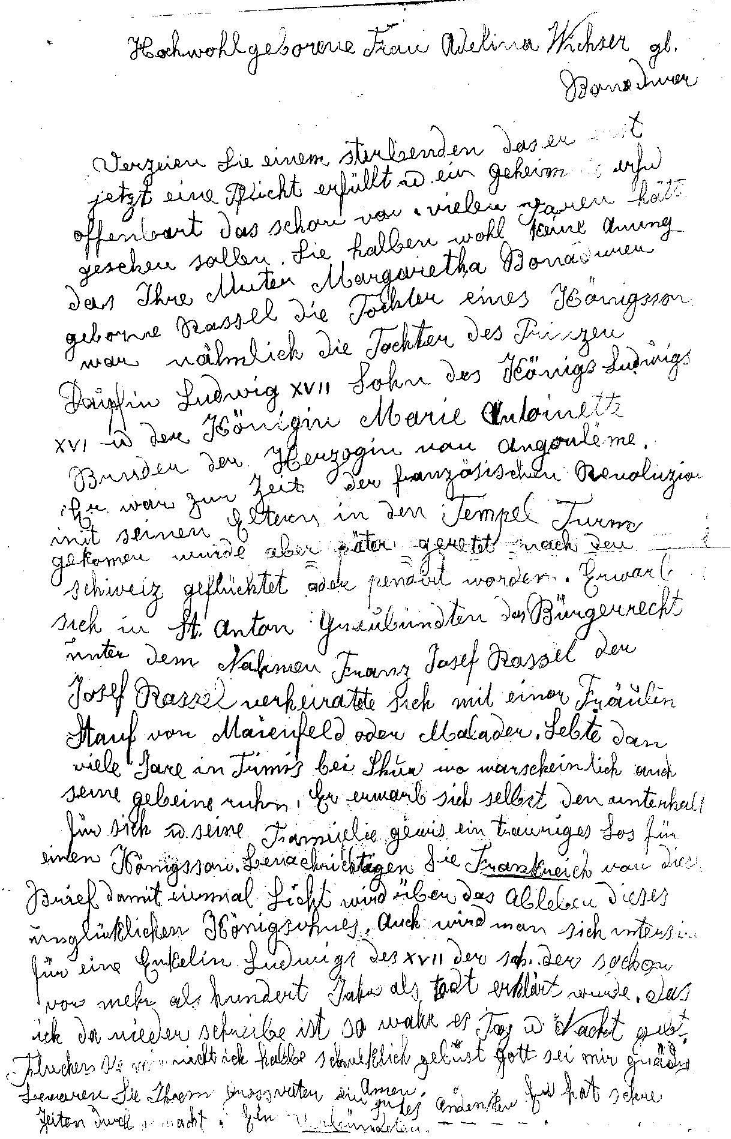
Letter to Mrs. Adelina Wichser-Bonadurer+ expand
Original Transcript · undated and unsigned
Most Esteemed Mrs. Adelina Wichser née Bonadurer —
Forgive a dying man for only now fulfilling a duty and revealing a secret that should have been disclosed many years ago. You probably have no idea that your mother Margaretha Bonadurer, née Rassel, was the daughter of a king's son, namely the son of Prince Dauphin Louis XVII, son of King Louis XVI and Queen Marie Antoinette, brother of the Duchess of Angoulême. He was brought to the Temple Tower with his parents during the French Revolution, but was later rescued and fled to Switzerland. He acquired citizenship in St. Antönien, Graubünden, under the name Franz Josef Rassel. Josef Rassel married a Miss Staub from Maienfeld or Malader. He then lived for many years in Trimmis, where his remains probably rest. He earned his own living for himself and his family — certainly a sad fate for a king's son.
Notify France of this letter, so that light may finally be shed on the demise of this unfortunate king's son. There will also be interest in a granddaughter of Louis XVII, who was declared dead more than a hundred years ago. What I write is as true as day and night.
Fleeing... not. I have atoned very honestly. God be merciful to me. Amen. Cherish a good memory of your grandfather. ... has gone through very difficult times.
An Ally — (undated and unsigned)
Unfortunately, the records end without dates and signature. Why does he write “An Ally”?
Original transcript of the letter listed above