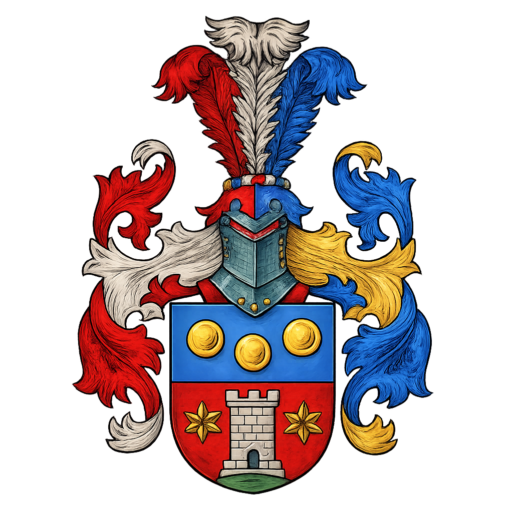


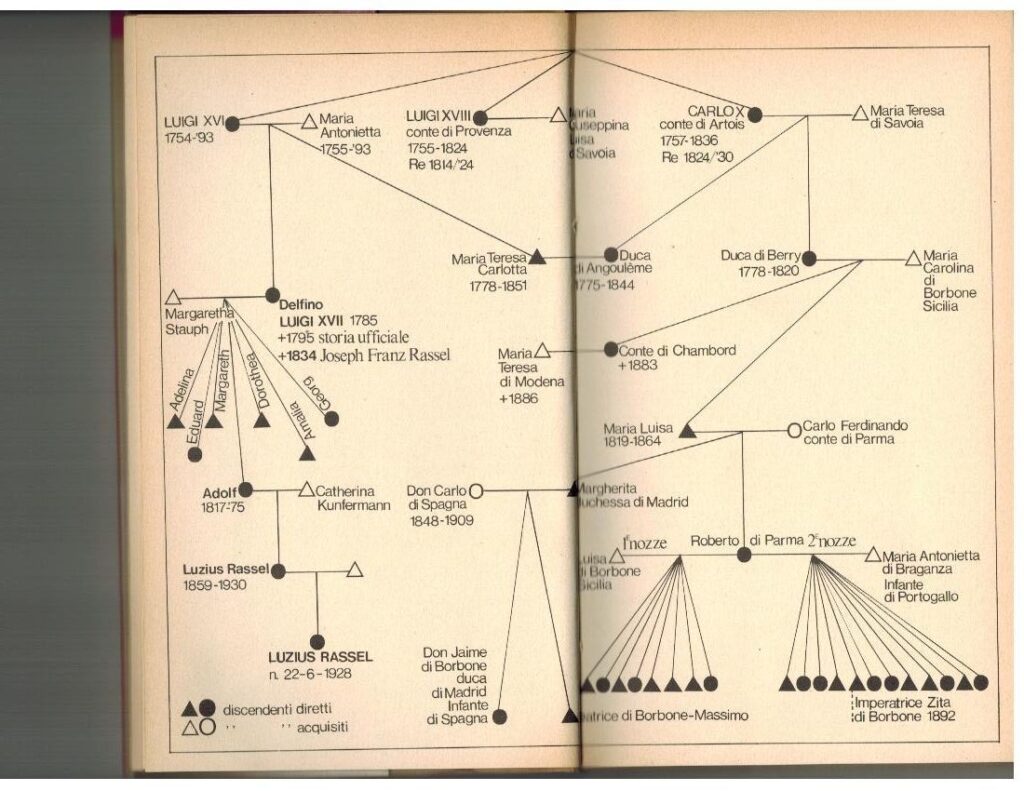
Ancestral Chart Rassel/Bonadurer.
The Rassel/Bonadurer ancestral chart examines the fascinating history of the possible connection to the French royal family (Louis XVI and Marie Antoinette) through the Rassel family tree.
Margaretha and Luzius Rassel
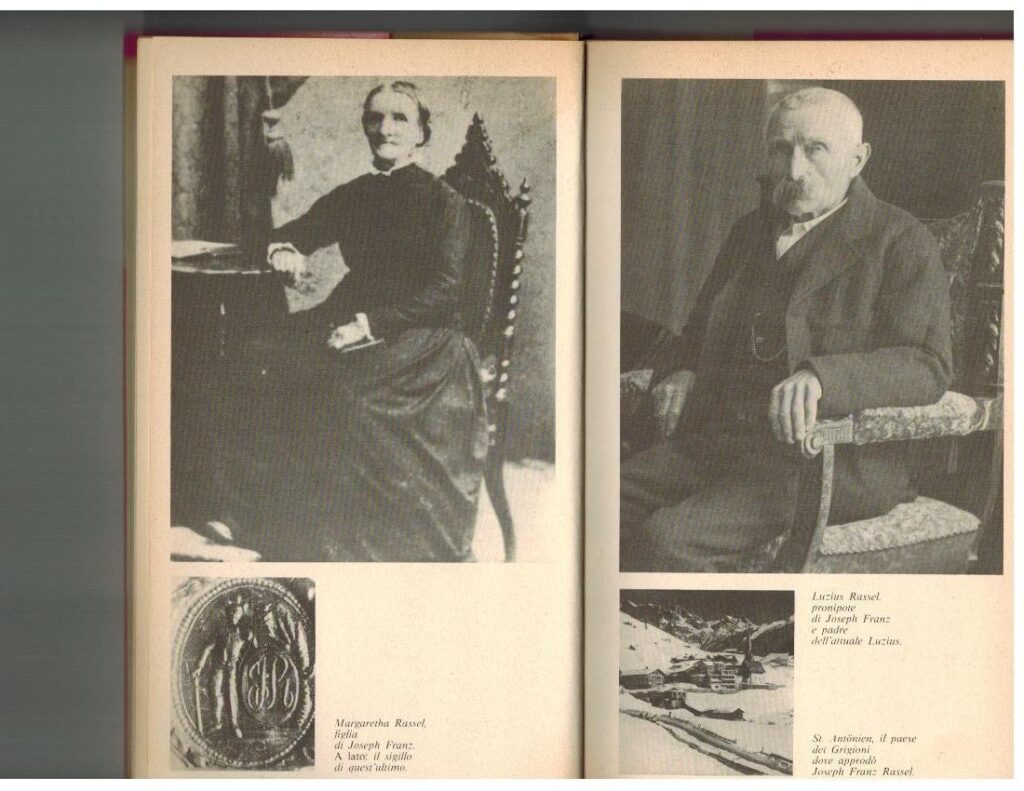
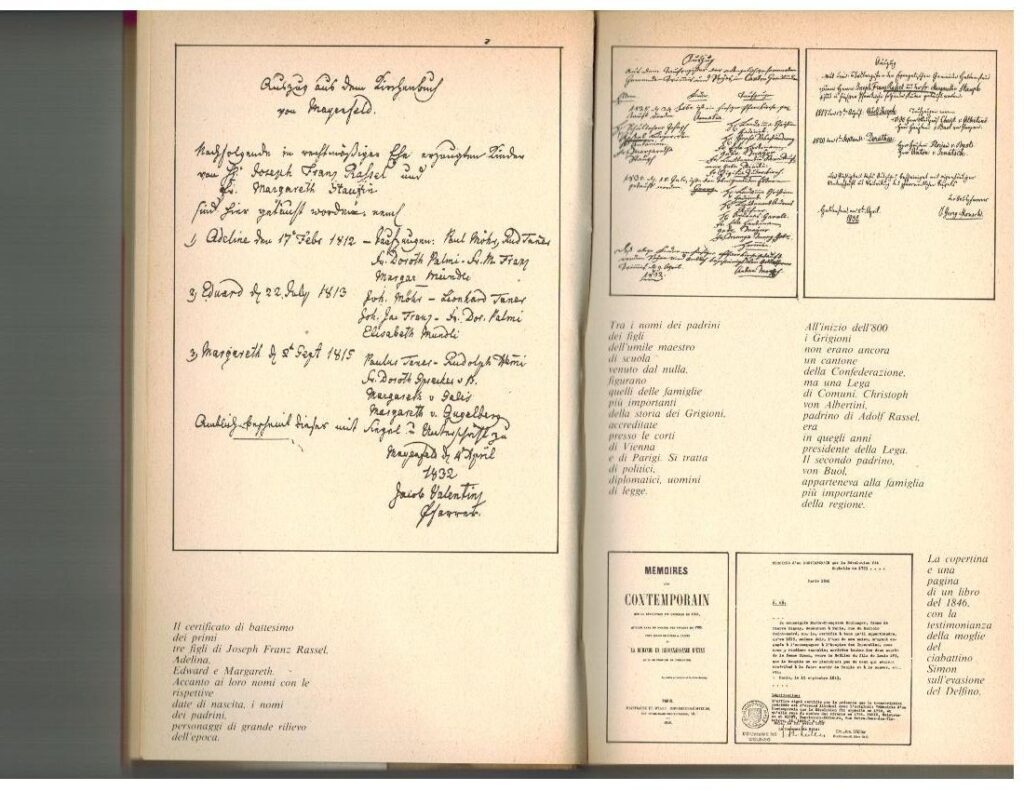
Document image Rassel letters under Ancestral Chart Rassel/Bonadurer
Upper right block (next to the round seal):
“The cover and one page of a book from 1846 containing the testimony of Sabatino Simon’s wife regarding the escape of the Dauphin.”
Middle block (next to the upper handwritten documents) “At the beginning of the 19th century, Graubünden was not yet a canton of the Confederation, but a league of municipalities. Christoph von Albertini, godfather of Adolf Rassel, was president of the league in those years. Von Buol, another godfather, belonged to the most prominent family in the region.”
Lower right block (next to the large handwritten document)
The baptismal certificate of the first three children of Joseph Franz Rassel: Adelina, Edward, and Margareth. Next to their names and respective birth dates are the names of the godparents, personalities of great importance at that time.”
Large section bottom left (Baptismal Register) Heading top left:
“Extract from the baptismal register of Maienfeld.”
The following children of Mr. Joseph Franz Rassel and Mrs. Margareth Stauffer, conceived in lawful marriage, were baptized here, namely:
Entry 1 (Adeline):
Original: “1. Adeline the 17th Feb. 1812. – Testes [Witnesses/Godparents]: Mr. Paul Maron, judge in Maienfeld, Miss Dorothea Polini, a[nd] Miss Margar[etha] Thürer.”
Entry 2 (Eduard):
Original: “2. Eduard the 22. July 1813 – Testes: Tit. [Titled] Nob. [Noble] a[nd] Highly Learned Mr. Joh. Anton von Albertini, Dr. Med. along with Elisabeth Mundi.”
Entry 3 (Margareth):
Original: “3. Margareth d. 5th Sept. 1815 – Testes: Paulus Sever, District Castellan, Tit. Mr. Dr. Jo[hann] Christoph von Albertini, Margareth v. Salis, Margareth v. Toggenburg.”
Closing note at the very bottom:
• Original: “Officially confirmed with seal and signature. Maienfeld d. 4. April 1832. Jacob Valentin, Pastor.”
Upper small documents (Brief insight)
The two smaller documents at the top left contain similar certificates and extracts.
• In the topmost document, “Extract from the death register of Maienfeld” is mentioned on the left.
• The second document below also concerns family confirmations, signed among others in “Chur” (capital of Graubünden) in 1836.
Main Text
The date is the only certainty: June 8, 1795. In the prison of the Temple—the grim fortress of the Knights Templar, dissolved in 1312 by Pope Clement V—a boy of approximately ten years of age, held captive there, dies.
Officially, for the republican government that emerged from the Revolution, there is no doubt: the severely weakened prisoner, who died from a prolonged illness with extensive purulent inflammations and swollen lymph nodes, is Louis-Charles Capet, the third son of Louis XVI and Marie Antoinette. Following the death of his elder brother Louis-Joseph on June 4, 1789, he had become the nominal heir to the throne of the now-overthrown French royal house.
It is precisely in this ancient fortress that Louis-Charles, born on March 27, 1785, has been held captive since 1792, together with his eldest sister Marie-Thérèse Charlotte. In that year, on August 12, the entire royal family—including the sister of Louis XVI, Elisabeth—was imprisoned by order of the National Assembly in the hastily prepared chambers of the Temple. Supervision was entrusted to the Paris municipal council.
“Citizen Louis Capet,” as the King was now called in official documents, had been sentenced to death by guillotine on January 15, 1793. The…….
This, then, is the beginning of a historical article about the fate of Louis XVII—the son of Louis XVI who died in the Temple prison—embedded within a family chronicle about Luzius Rassel. In brief: the text addresses the doubts surrounding the death of Louis Charles, son of Louis XVI and Marie Antoinette. Officially, he died in 1795 in the Temple, but there are many indications that the deceased child was someone else.
The Two Letters:
- A letter from Pope Montini (later Paul VI), then Pro-Secretary of State, to the representative.[Tereschnidi]
- The Secretariat of State cancels the meeting with the Pope.
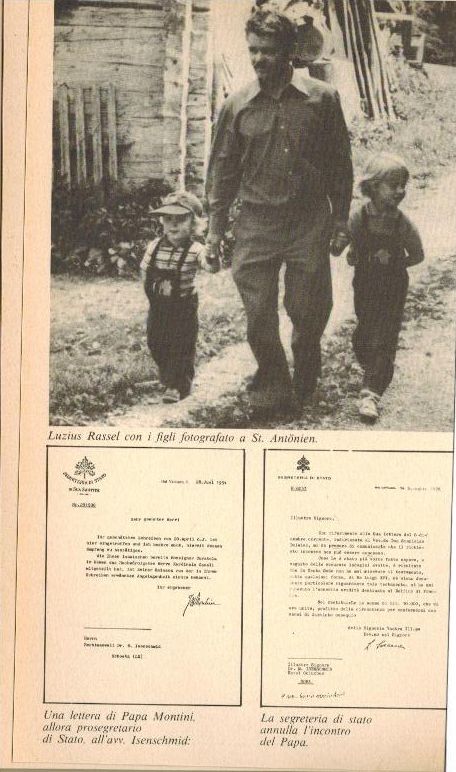
Transcription (Original German, Vatican):
1. Letter from Giovanni Battista Montini – October 6, 1953
SECRETARIAT OF STATE
OF HIS HOLINESS
Prot. No. 21229
From the Vatican, October 6, 1953
Dear Sir,
Your esteemed letter of April 26 of this year has arrived here, and we hereby confirm its receipt.
As Monsignor Tardini has already informed you in the meantime on behalf of His Most Reverend Eminence Cardinal Canali, His Holiness has no knowledge of the matter mentioned in your letter.
Yours faithfully,
[Signature: G.B. Montini]
———
To
Attorney Dr. R. Jecklin
Samedan (Engadin)
Explained in English: Montini merely confirms receipt of your letter of April 26, 1953, and states quite diplomatically: Cardinal Canali has already conveyed through Tardini—the Pope has no knowledge of the matter you have presented.
This corresponds exactly to the caption in the article: “A letter from Pope Montini, then Pro-Secretary of State”
2. Letter from the Secretariat of State – Cancellation of Papal Audience (undated, circa 1954)
Esteemed Sir,
with reference to your esteemed letter of the 5th of this month, I inform you that the audience you requested cannot, regrettably, take place.
As you are aware, the Holy See has, in view of present circumstances, refrained as a matter of principle from granting audiences of particular significance. I therefore ask for your understanding that your request cannot be accommodated.
With distinguished regards,
This is the second caption: “The Secretariat of State cancels the meeting with the Pope.”
Both letters are addressed to the same man—Attorney Dr. R. Jecklin of Samedan (Engadin). In 1953, he had submitted a petition to the Vatican on behalf of Luzius Rassel (the man in the photograph with his sons)—evidently in connection with the story of Louis XVII recounted in the main article (the theory that Louis-Charles survived the Temple).
The Vatican responds twice, very politely but firmly:
- 1953: “We have received your letter; the Pope has no knowledge of the matter.”
- 1954: “The audience will not be granted.”
In short: Rome did not pursue the Rassel/Jecklin theses.